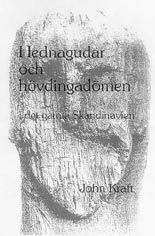
| Hednagudar och
hövdingadömen
- det gamla Skandinavien /ukd/kraftbok.htm UKF:s startsida
John Krafts bok har med rätta rönt stor uppmärksamhet. Sedan den kom ut i oktober 1999 skickar vi 2-3 böcker varje dag till personer över hela landet. Många har nämligen väntat på den i flera år. Boken handlar inte specifikt
om Upplands-Bro,
men man kan säga att den gör ett intressant avstamp här.
Centralt i John Krafts forskning har varit de forntida labyrinterna,
och
vår labyrint vid Rösaring har - inte minst av John
själv-
lyfts fram som verkligt betydelsefull. Gudars och gudinnors namn återfinns ibland i vissa ortnamn. Dessa har ofta mycket hög ålder och John har med deras hjälp spårat en samhällsstruktur redan under forntiden, således före alla skrivna dokument. Härnevi och Ullevi i Bro hade redan 1912 framställts som typexempel när det gällde fruktbarhetsdyrkan kring gudaparet Härn och Ull. När Ortnamnssällskapet firade sitt 50-års jubileum 1985 var dessa åsikter åter i forskningens fokus och vårt Härnevi och Ullevi spelade en central roll i högtidstalet. När detta senare trycktes i årsskriften illustrerades artikeln med kartor över Härnevi och Ullevi i Bro. John Krafts bok och det den representerar har ända sedan jag lärde känna honom på 1970-talet varit en del i min framställning av den fruktbarhetsdyrkan som förknippas med såväl Rösaring som skålgroparna i Härnevi. John Kraft (född 1944) har dagsnyheterna som yrke och forntiden som hobby. Sedan 1970 har han arbetat som ledarskribent (Upsala Nya Tidning 1970-80 och Vestmanlands Läns Tidning sedan 1980). Tidigt fick nyhetsarbetet samsas med ett växande fritidsintresse för historia och arkeologi. Allt mer har detta intresse förskjutits till den dunkla tiden före Sveriges kristnande. Efter arkeologistudier i Uppsala i mitten av 70-talet har författaren, som entusiastisk amatör, specialstuderat en fascinerande och dittills tämligen försummad typ av fornlämningar, nämligen labyrinter, eller trojeborgar som de ofta kallats i folkmun. Ett stort material har inventerats i arkiv och genom fältstudier. Resultaten har redovisats i ett 50-tal artiklar och uppsatser. Labyrinterna har antagligen tjänat som arenor för fruktbarhetsriter i förhistoriska samhällen. Ett sätt att få mer grepp om dessa samhällens omfattning och kult är att även studera de kultplatser som lämnat spår i form av teofora ortnamn, t ex Ullvi, Odensvi och Torslunda. Materialet och analysen har växt. Det har också arbetsinsatserna gjort. Det som började som ett roande tidsfördriv har blivit en absorberande hobby. Författaren, som aldrig tänkt bli arkeolog och inte avsett att skriva någon bok om ortnamn, har gradvis övermannats av ämnet och publicerar nu en bred studie av sakrala ortnamn. Det visar sig möjligt att skissa hela Skandinaviens indelning i hövdingadömen under järnåldern. Studien ger också ledtrådar till i vilken tidsordning de hedniska gudarna etablerats. 260:- på biblioteken. 236 sidor i stort format.
Rikt illustrerad.
Summary (Hednagudar och hövdingadömen) Through an analysis of the distribution pattern of sacral place names it is possible to reconstruct the map of chiefdoms or "cult-unions" during different phases of the iron age. 67 Scandinavian chiefdoms of the early iron age can be traced and mapped in this way. Later some of them seem to have been united in larger units while others are split into smaller chiefdoms. The hypothesis is simply that the sacred places of the heathen days, today indicated by place names like Torsåker, Odenslunda and Frösvi, were evenly distributed, one of each type in every prehistoric chiefdom. In the same way as it is possible to get an idea of the number of Christian parishes in the countryside by counting churches, it should be possible to reconstruct the heathen societies by comparisons of identical cult names. According to the hypothesis three identical place names like Ullvi give at hint of three prehistoric chiefdoms. These geographical patterns grow in strength when place names with other gods are distributed in the same way. The distribution of such place names can also indicate changes of the prehistoric map, such as mergers or splits of chiefdoms. The reliability of the method can be tested i Norway where the old chiefdoms of the ninth century are well known thanks to Snorri Sturlasson's detailed account of Norway's early history. Particularly along the Norwegian west coast Snorri's account fits perfectly to the map reconstructed by the method of counting identical heathen cult names. In addition to the cult names the study also deals with early ting places, particularly ting mounds, and some probably prehistoric labyrinths. The size of the reconstructed chiefdoms differ considerably. The smallest seem to have had only a few dozen farms or villages, while the largest had 700-800, or more farms at the end of the heathen time. Among the largest chiefdoms were Scania (Skåne), Själland and Gotland. The area around Lake Mälaren was a mosaic of mainly rather small chiefdoms while the long, but sparesly populated coast of northern Sweden was united in one vast chiefdom. It is in many cases possible to guess the names of the
prehistoric chiefdoms.
Some of them have survived as names of provinces like Skåne,
Halland,
Öland, Gotland, Värmland, Dalarna and Hälsingland.
The oldest place names are probably those containing a possible goddess Skädja (Skadevi, Skädharg, etc). Place names with the god Ull and the fertility goddess Njärd (=Nerthus), such as Ullvi, Ultuna, Närlunda etc are probably a bit younger. Nerthus is mentioned by the roman Tacitus 98 AD. The fertility god Frey and the goddess Freyja, ocurring in place names like Frösvi, Frövi, Frölunda etc, seem younger than Ull and Njärd. Tyr is probably established after Frey and Freyja. His place names are only found in Denmark. Odin's place names, Odensvi, Odenslunda etc, seem younger than those of' Tyr. Thor's place names are probably the youngest. Gods belonging to the "Æsir" like Tyr, Odin and Thor seem to have been introduced in Scandinavia, from the south, while fertility gods like Ull, Njärd, Frey and Freyja have a longer history in the north. The labyrinths have probably reached Scandinavia, from the
Meditteranean,
some time during the first millennium BC. The seemingly oldest
labyrinths
in Sweden fit in to the same geographical pattern as the place names of
the oldest types: Skadevi, Ullvi and Närlunda. The labyrinths are
usually found in the central parts of these chiefdoms.
Summary in English (Tidiga spår av Sveariket) In my previous book on heathen gods and chiefdoms in ancient Scandinavia (Hednagudar och hövdingadömen, 1999) I attempted to reconstruct the pattern of prehistoric chiefdoms in Scandinavia with the help of place names referring to heathen gods, for example Odensvi and Torslunda. My theory is that names of a particular kind are only found once in each district or chiefdom. The maps of the chiefdoms can be useful in shedding light on many other riddles of the past. In this book I have set out to show how this can be done, discussing a variety of research subjects which can be better understood by referring to the distribution pattern of the old chiefdoms of Sweden during the Iron Age. The reliability of the maps is demonstrated by their usefulness in these applications. Jordanes' account of Scandinavian tribes in the sixth century AD has been found to fit very well with the chiefdoms as reconstructed from place names. The map of chiefdoms has provided new input to discussions on the large mounds in the provinces around Lake Mälaren in central Sweden. It would seem that local chieftains have been buried there in large mounds since the eighth century AD. The largest mounds probably contain the graves of kings who ruled over several chieftains, and most likely over the entire region of Svealand (the provinces around Lake Mälaren). Such rulers have probably been buried in large mounds since about 500 AD, and possibly from the fourth century AD. It has been shown how the early Christian church can have adapted its organisation from earlier structures, with the dioceses corresponding to lands (lagsagor). The deans presided over districts based on and often identical with chiefdoms. Many of Scandinavia's early cities, established in the thirteenth century, were preceeded by market places. The old market locations correspond well with the distribution of chiefdoms. As a rule one such market place could be found in each chiefdom, favourably situated in the best available location. Over time, the region around Lake Mälaren was divided into subdistricts which were called hundare or "hundreds". Several of these subdistricts seem to have taken over the older names of chiefdoms. By the Middle Ages the region of Uppland in middle Sweden consisted of three provinces or "folklands" whose names allude to the number of hundare in each, with Tiundaland having ten (tio), Attundaland eight (åtta) and Fjädrundaland four (fyra). The names of the three folklands would suggest a total of 22 hundare in Uppland, but my analysis has indicated that there were in fact 25 of them. A fourth province containing three hundare was divided by the neighbouring folklands so that each added an extra one to its territories. Before this happened, the neighbouring folklands of Uppland appear to have been identical with the four chiefdoms which can be traced there during the early Iron Age. At an earlier stage there were probably only 20 hundare in Uppland, but over time five of them would be divided in two, resulting eventually in a total of 25. At the beginning of christianization royalty seem to have supported the new religion by building or allowing the building of churches at market places and at a settlement type known as husby, which was typically a royal farm. This resulted in one church for each chiefdom, and probably explains why some churches still have names of the husby type, eg. Husby-Ärlinghundra. At a later stage when the new religion had triumphed, a number of new churches appear to have been built, one in each hundare. Often these were at places with "tuna" names and close to "thing" places (tingsplatser) where laws were enforced in the subdistricts (hundare). Some husby settlements and other royal farms would be used as residences by the king when travelling. At an early stage there seems to have been one such residence in each chiefdom. Later this number may have been reduced somewhat. The large mounds found close to several royal recidence locations indicate that the residences were already being used by kings in the fifth century AD. Most husby places, however, seem to be more recent than that and were probably just used for storing goods collected as taxes and to house representatives of royalty. Usually there would be one husby in each hundare. The fact that many early churches were built at farms with tuna names indicates that these places had an important role in prehistoric society. I would guess that they were heathen cult places. The oldest places with tuna names can be traced back to the Roman Iron Age. At that time there was probably one such place per chiefdom. At a later stage every subdistrict or hundare seems to have a place with a tuna name. Later still, every boat's crew (skeppslag) seems to have a place with a tuna name. Through analysis of tuna names it is possible to trace the organisation of maritime defence in certain areas, particularly in the region of Sörmland, Sweden. Overall this work reveals ancient Sweden as a rather well
organised
kingdom in which the rulers travelled from one special residence to the
next, overseeing the various chiefdoms.
Ledung och sockenbildning The Swedish
naval system of the early Middle Ages was known as the ledung. It is
difficult
to get a good idea of its organisation since there are no written
records
giving sizes or numbers of ships. We can get some insight, however, by
studying
the taxation system, which in the Middle Ages was to a large extent
based on
the organisation of the fleet and its mobilization units. Another way
to throw
light on this ancient system of warfare is to study the formation of
parishes,
which in various ways was influenced by the regional organisation
already laid
down for the fleet.
At some earlier stage, it seems there were
even fewer ships in the Swedish fleet, around 100, probably with 24
oarsmen in
each. At that time, many hundaren would have been the equivalent of
skeppslag.
Thus it is probable that the hundaren had originally been created as
skeppslag,
and that their cult and judicial functions were secondary to their
naval role.
Much points to
In large areas of
The Swedish ledung fleet's role was from
the beginning an offensive one, focused on raiding and controlling the
peoples
across the The formation of parishes in
At a third stage, the number of churches
increased even further. In forested areas, parish distribution was
largely
governed by the natural environment. In more densely populated regions
there
are many examples of naval districts influencing the establishment of
parishes.
In the provinces of Västmanland and
Uppland, some hundaren contained parishes identical with quarters of
skeppslag
(skeppslagsfjärdingar), but in most hundaren the new parishes were
formed
without reference to the naval districts. In much of Sörmland, it
seems that an
early church was built in each skeppslag, but later churches occur
independent
of the naval districts. In west The
regional differences characterising the progression and intensification
of
church building suggest that each of the bishoprics was free to develop
along
its own lines. Translation
by Heather Robertson
Provsida 1 - Materialet Provsida
2 - Rekonstr av kultförbund Provsida
3 - Labyrint i Badelunda
|